Hot: Skin Analyzer PDT Skin Machine Hair Growth Device Home Phototherapy

Children make up a small share of phototherapy volume and a disproportionate share of the risk, because every parameter that is forgiving in an adult - dose step, session length, who holds the device - is unforgiving in a six-year-old.
The devices are the same ones clinics already buy. What has to change is the protocol, the supervision and the printed material that goes out with the unit.
Three things differ. The skin is thinner, so a dose that produces a mild erythema in an adult can burn a child at the same setting. The body surface area is smaller, so a hand-held unit covers a larger fraction of the body and the total exposure per session is higher than the area suggests. And the patient cannot self-report, so the adult in the room becomes part of the treatment device.
There is also a planning difference. A child may need phototherapy for years, across growth spurts, school terms and holiday gaps. Protocols that assume an unbroken course of thirty sessions fit adults better than children.
Scheduling is the second constraint. Sessions that fit an adult's evening do not fit a school week, so most paediatric programmes run after school and on Saturday mornings, which halves the usable slots and stretches a course that would otherwise finish in six weeks. Quote throughput per week rather than per day when a clinic asks how many children a room can take - the honest answer is usually a third of the adult figure.
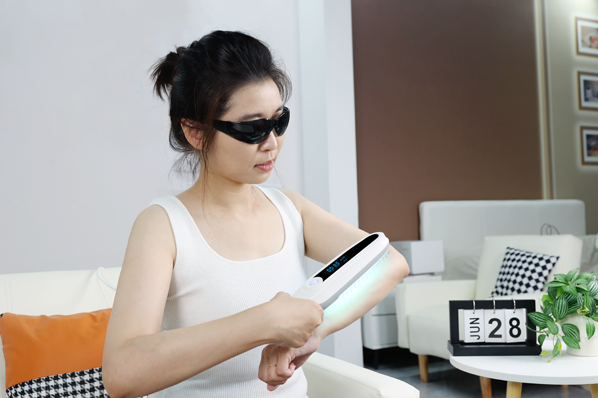
The adult in the room is part of the treatment: goggles on, timer set, dose written down.
Paediatric protocols start below the adult dose for the same skin type, typically at half to two thirds of it, and step in smaller increments. Two rules matter more than the exact numbers:
The common failure is not a wrong dose at the clinic, it is an unsupervised session at home where a parent extends the time because nothing appeared to happen in the first fortnight. Devices with a visible countdown and a locked maximum time remove most of that failure mode.
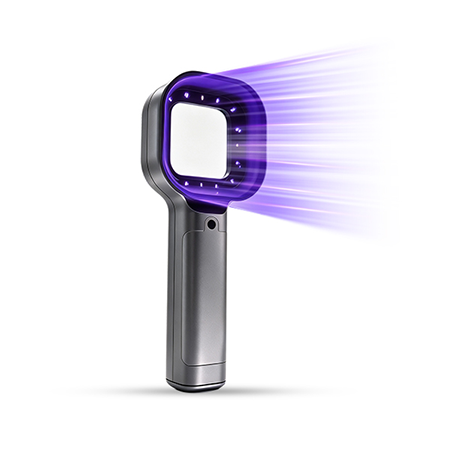
For a child, the decision is usually driven by how still they can be and how much area needs treating. A panel or lamp treats a limb or the trunk with the child seated and the distance fixed; a hand-held unit suits small patches and joints but invites over-treatment because it is easy to keep moving; a comb is the only practical option for the scalp.
Where the family can only manage short sessions, a device that reaches the target area in ten minutes will be used, and a better device that needs twenty will not. That is a specification question, not a marketing one.

Small areas, fixed distance, short sessions: the format that a child will actually sit through.
Distributors win or lose this segment on the paperwork, because the clinic is handing a device to a family. A minimal pack includes a paediatric dosing card per skin type, a supervision agreement for the parent to sign, a session log, a goggle sizing guide and a named contact for questions.
Add a short note on what the device is not for: no home escalation without review, no treatment of the eyelids, no shared goggles between siblings without cleaning.
Supplying paediatric phototherapy? Ask us for the dosing card, supervision agreement and goggle sizing sheet in your market's language.
【Editor】admin
 Address
2nd Floor, 1-101,Building 6, Xuzhou , LIANDO U Valley, 6# Leye Road, Damiao Street, Jiangsu Province, China
 Email
info@diosole.com
 Tel/Whatsapp
+86 18914846950
 Facebook
18914846950