Hot: Skin Analyzer PDT Skin Machine Hair Growth Device Home Phototherapy

Phototherapy works in skin of colour for the same reasons it works in lighter skin. What changes is the information available to the clinician: erythema is harder to see, minimal erythema dose varies more widely within the same Fitzpatrick group, and pigment change is both a side effect and, in vitiligo, part of the outcome.
The practical consequence is that dose decisions lean more on the calendar and the patient's report, and less on the visual check that works in type II skin.
The Fitzpatrick scale was built to predict sunburn risk, not to set phototherapy doses, and within types IV to VI the spread of minimal erythema dose is wide enough that a table alone is a poor guide. The safe response is to start at the conservative end for the stated type and let the first two sessions tell you more than the questionnaire did.
Post-inflammatory hyperpigmentation and hypopigmentation are both reported after phototherapy in darker skin, and both are more likely with high cumulative doses, rapid escalation and the higher energy density of targeted 308 nm treatment. Neither is usually permanent, but 'usually' is doing a lot of work in that sentence, and patients deserve to hear it before session one rather than after session twenty.
In type V and VI skin, visible redness may be absent at a dose that has already injured the skin. Clinics that rely on the visual check alone tend to escalate too far and discover the reaction as desquamation a week later. Substitute three other signals.

The starting dose and the consent conversation change with skin tone; the treatment goal does not.
Two device properties become more important as the starting dose becomes more uncertain: irradiance stability over the session and uniformity across the treatment area. A device with a hot spot in the centre of the field produces a localised reaction that looks like a dosing error and is really a uniformity error.
For localised disease, 308 nm targeted devices concentrate energy in a small field and are efficient, but the same concentration makes an escalation mistake more damaging. Ask for irradiance at the treatment distance and a spot size that matches the lesion rather than the largest available aperture.
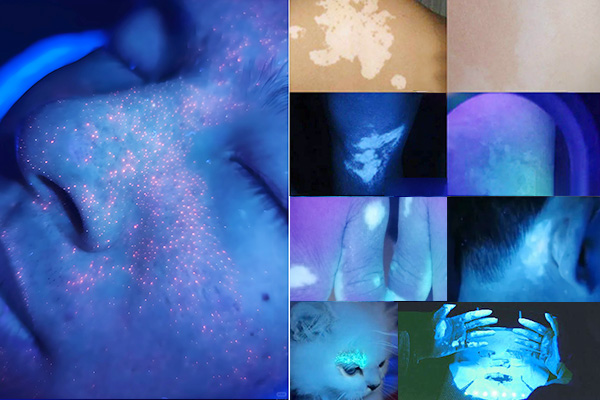
Baseline imaging makes pigment change visible later, when memory has already normalised it.
Vitiligo is where skin of colour and phototherapy intersect most often, and it is also where over-treatment is most tempting, because the treated area does not redden the way a psoriasis plaque does. Keep the escalation slow, score with VASI or a body-site measure at fixed intervals, and accept that a twelve-week review is early.
Two practical notes. Do not combine home phototherapy with unsupervised sun exposure, because the total dose becomes unknown. And treat the visible, high-contrast areas - face, hands, neck - on a schedule the patient can sustain, because consistency beats intensity in vitiligo more than in any other indication.
A consent conversation covering pigment change, the realistic timeline and the stopping rules takes ten minutes and prevents most of the disputes that follow. Write the three points into the record, with the patient's stated skin type and the source of that assessment.
Review every four weeks with a photograph and a single score. If the score has not moved by week twelve, change the plan rather than the dose.
Working with darker skin types? Ask for our dose ladder template and the photography protocol that ships with it.
【Editor】admin
 Address
2nd Floor, 1-101,Building 6, Xuzhou , LIANDO U Valley, 6# Leye Road, Damiao Street, Jiangsu Province, China
 Email
info@diosole.com
 Tel/Whatsapp
+86 18914846950
 Facebook
18914846950