Hot: Skin Analyzer PDT Skin Machine Hair Growth Device Home Phototherapy

Hands, feet and joint folds take up a small share of the treated surface and a large share of the complaints in any phototherapy service. The disease is visible, itchy and slow to clear, and the anatomy works against every device format on the market.
The protocols that work are unglamorous: a fixed distance, longer times than the trunk, separate sessions for hands and feet, and a written record of which area received which dose.
Three anatomical facts explain most of the disappointment. The stratum corneum on palms and soles is thick and scatters light before it reaches the plaque. The surface is curved and folded, so a flat beam meets it at an angle and delivers less than the meter suggests. And the target is small, which tempts clinics to treat it as an afterthought at the end of a whole-body session.
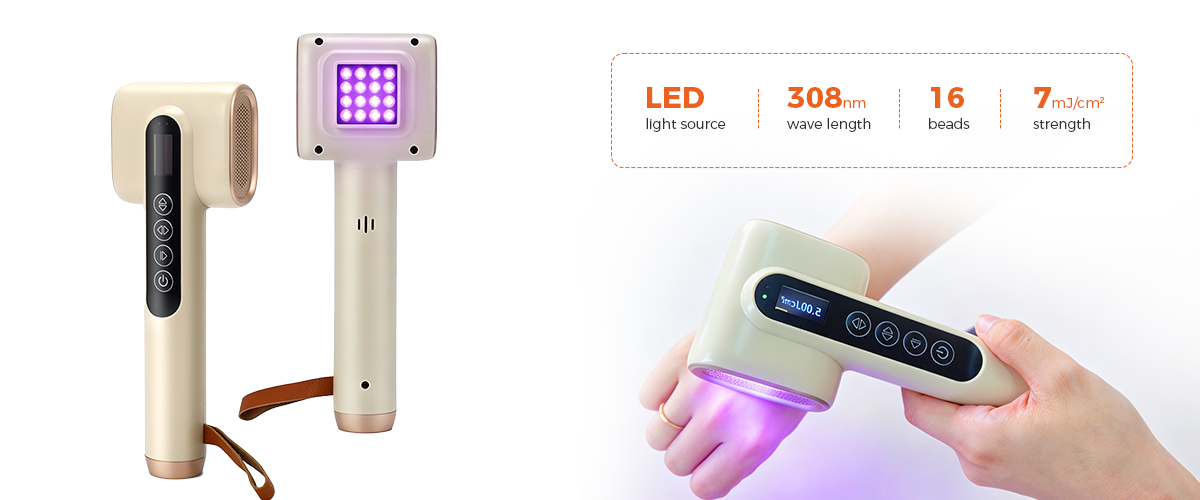
The same emitter at close range on hands and feet: format matters more than peak output.
Palmoplantar protocols usually end up well above trunk times, but starting there is the fastest way to burn the thin skin on the dorsa of the hands. Start at or slightly below the trunk starting dose for the patient's skin type, escalate on the same schedule, and let the palms run ahead only after two sessions without reaction.
Most under-dosing on hands is a positioning failure. If the hand is held at an angle, half the beam lands on the sides of the fingers and the plaque receives less than half the intended dose. A flat rest surface, a marked outline and a fixed lamp height solve it more reliably than a stronger lamp.
Soles are the same problem upside down: the foot rolls outward, the arch shades itself, and the heel receives more than the metatarsal heads. A simple jig - a board with a foot outline and a stop for the heel - removes the variation between operators and takes an afternoon to make.
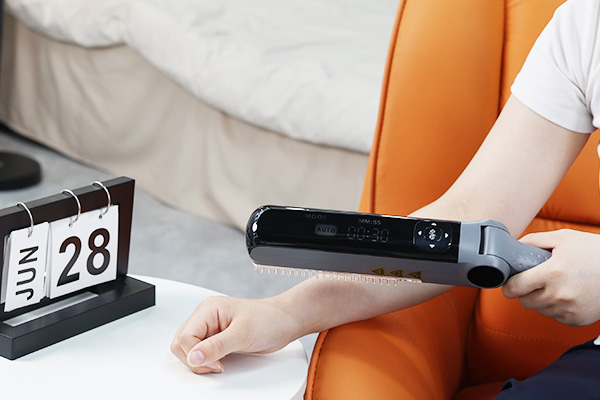
A rest surface and a marked outline do more for dose consistency than a higher output.
Extensor surfaces over elbows and knees tolerate dose well. Flexures do not. Treating a flexural plaque at the dose used on the extensor surface of the same joint produces a fissure that takes longer to heal than the original lesion, so the two are dosed separately and the flexure is shielded during the extensor session.
Small joints - knuckles, the sides of fingers, the malleoli - are usually treated with a hand-held unit at short distance. Keep that distance fixed with a spacer rather than relying on the patient to hold steady for several minutes.
Nail disease is where patients give up first. Nail plates grow out over months, so the visible change lags the treatment by a quarter, and a clinic that reviews at week six will conclude that nothing is happening. Set the expectation at the first visit, photograph the nail at baseline and review at three months rather than six weeks.
There is also a limit worth stating: phototherapy alone rarely clears nail disease quickly. The protocol that works is the one a patient can continue for two quarters without losing faith.
For a mixed list, the practical answer is a body device plus a hand-held unit with a small aperture and a spacer. For a clinic that treats palms and soles as a specialty, a panel with a flat rest surface and a fixed distance is faster per patient than a hand-held unit, because the patient can be left in position while the timer runs.
Whichever format, ask for irradiance at the treatment distance rather than at the aperture, a timer the patient cannot extend, and a treatment window that can be cleaned between patients without clouding.
Treating palms, soles or joint disease? Ask which format and aperture we recommend for that list.
【Editor】admin
 Address
2nd Floor, 1-101,Building 6, Xuzhou , LIANDO U Valley, 6# Leye Road, Damiao Street, Jiangsu Province, China
 Email
info@diosole.com
 Tel/Whatsapp
+86 18914846950
 Facebook
18914846950